Personalization often breaks before anyone writes the content.
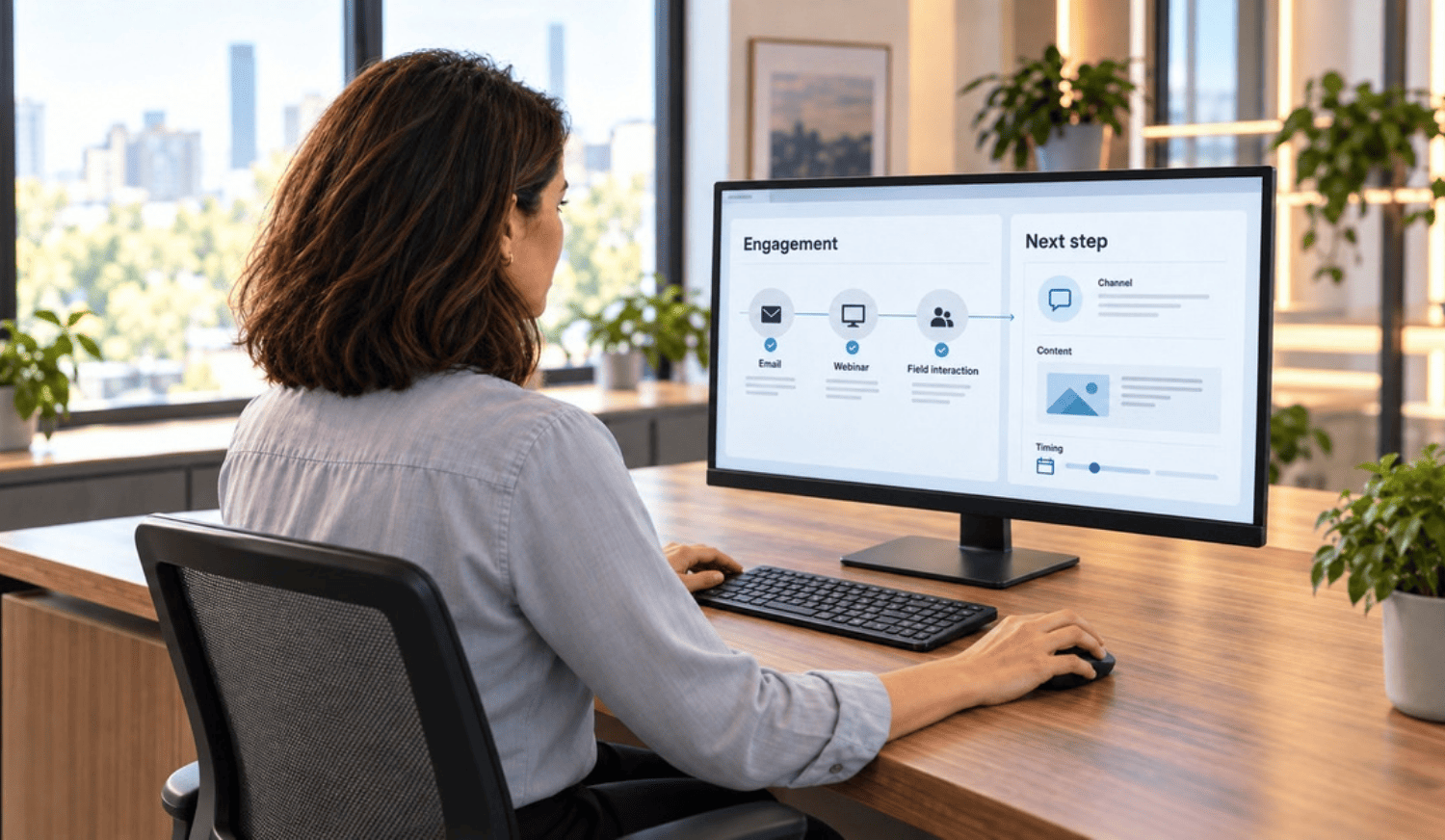
Commercial and Omnichannel teams may have engagement data from emails, webinars, content portals, field visits and CRM systems. Yet when those signals remain disconnected, teams still reconstruct journeys from spreadsheets, previous presentations or individual knowledge.
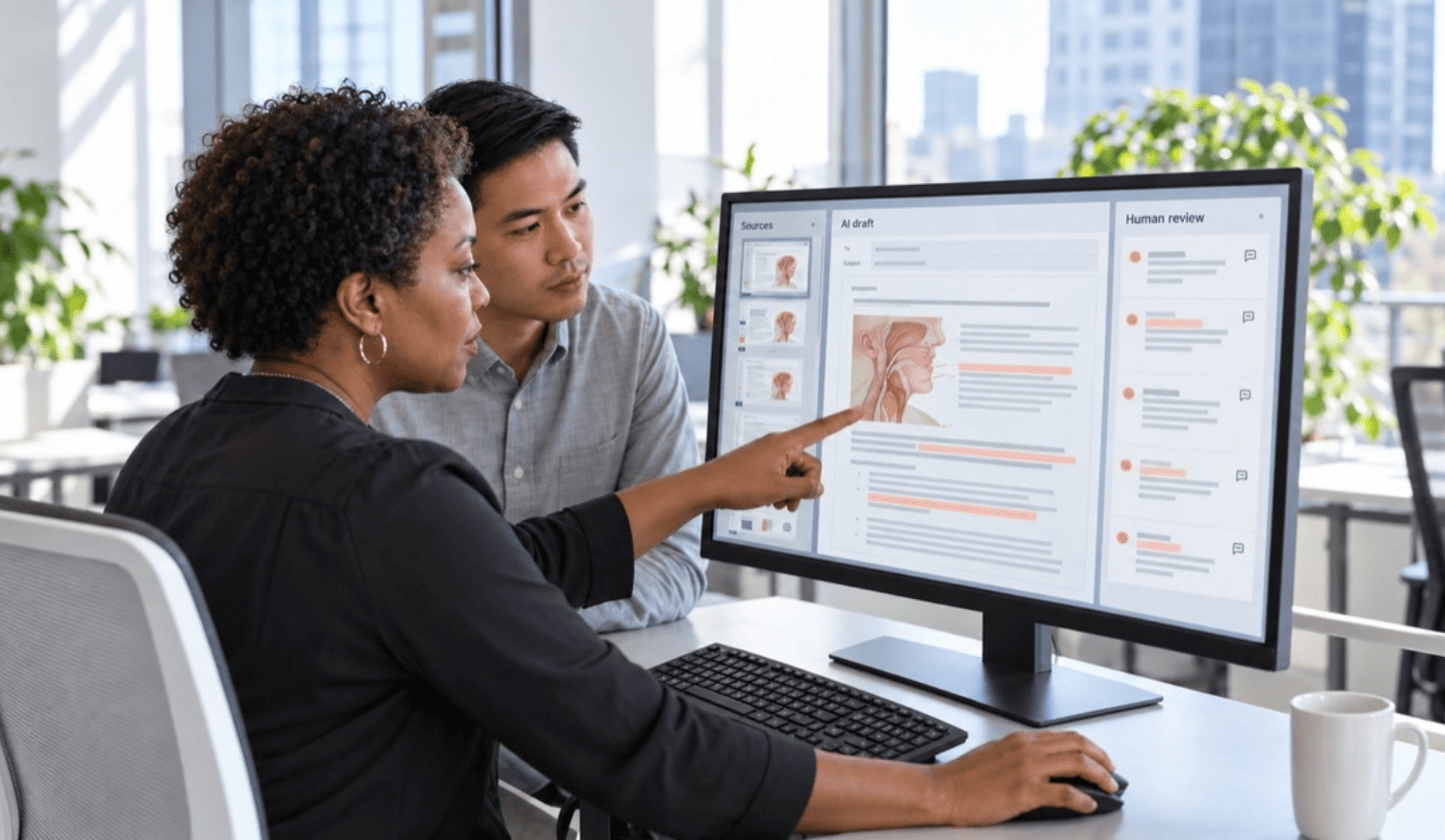
HCP journey personalization then becomes an exercise in producing more variants rather than improving the next interaction. An AI-enabled assistant can help teams connect permitted engagement signals, structure a reviewable journey and recommend relevant approved content based on those signals. But it needs usable data, defined rules and human oversight.
More engagement data does not guarantee better insight
The challenge is turning existing data into a timely decision.
Commercial Operations may coordinate the process, Analytics prepares datasets, Content Operations manages approved materials and national and regional teams provide market context. Medical, Legal and Regulatory stakeholders provide the necessary review and controls around what can be communicated and how. When each function works from a different view, personalization slows down and assumptions fill the gaps.
A Deloitte global survey of more than 190 HCPs and 50 executives from leading pharmaceutical companies found that 82% of life-sciences executives were satisfied with their engagement strategies, while only 28% of HCPs felt those strategies met their needs.
Channel preferences matter when designing an HCP journey. IQVIA’s 2025 Channel Preference Survey, based on more than 33,000 HCPs across 38 countries, including the US, reports preferred-versus-received channel alignment for major European markets. It does not provide a separate US alignment figure. US teams should therefore check planned journeys against permitted HCP preference and engagement data, where available, rather than assume a static segment reflects current behavior.
Manual journey reconstruction consumes capacity
Fragmented data creates work before the team can make a marketing decision. People export interaction histories, reconcile identifiers, check communication permissions, locate approved content and translate the result into a journey that campaign tools can use.
The cost is rarely tracked as one line item. A transparent internal model is more useful than a universal benchmark.
ILLUSTRATIVE EXAMPLE Six regional or brand teams run four recurring HCP journey cycles each year. If each team spends 16 hours gathering engagement data, reconciling inputs and rebuilding the journey, the process consumes 384 hours. If a reusable structure reduces that preparation by half, it frees up 192 hours. At an illustrative blended cost of $100 per hour, that represents $19,200 of annual capacity.
This is not a promised saving. It excludes software, data, integration, change management and governance costs. It gives Commercial Operations a baseline to replace with its own journey volume and effort.
One national program, three regional journeys
Consider a national cardiology team planning follow-up after a congress across the Northeast, Midwest and Western regions. The available signals include registration and attendance, questions asked, content viewed, previous email engagement, field interactions, declared channel preferences and communication permissions.
An AI-enabled assistant works with permitted data and approved rules to organize those signals. It produces a structured journey for review rather than automatically contacting the HCP. Depending on the available evidence, the proposed next step might be an educational follow-up, a representative conversation, a referral for Medical Affairs review where appropriate, a later touchpoint or no communication.
It can also recommend relevant approved content and timing, explain which signals informed the proposal and flag where data is missing or conflicting. Where the business has defined the necessary rules and governance, the same foundation can support Next-Best-Action recommendations.
Regional teams then adapt the journey to their audience and operating context. Commercial and Omnichannel teams gain a stronger basis for engagement planning, channel strategy and content selection. The company’s established MLR process remains in place. Any potential scientific interaction is routed to Medical Affairs for independent assessment.
What an AI-enabled journey assistant should do
A practical solution should:
- work with prepared data or support the ingestion, cleaning, linking and analysis of permitted engagement data;
- use only approved and permitted data, rules and content;
- combine relevant HCP, product, content and audience information;
- surface channel, timing and content-preference signals without presenting inference as fact;
- generate a structured journey and content recommendations based on defined rules and approved inputs;
- show sources, assumptions, missing data and applicable compliance notes;
- preserve versions and a clear review history; and
- let teams review, adapt, approve and reuse the journey.
The objective is to reduce the manual work between available signals and a decision that the responsible team can evaluate.
Governance must be designed into HCP journey personalization
The assistant should not determine compliance, override defined rules or activate a journey without approval. It operates within approved content, defined rules and the company’s established review workflows.
For prescription drug promotion, the FDA’s Office of Prescription Drug Promotion works to ensure that communications are truthful, balanced and accurately communicated. Journey recommendations should therefore use approved materials and follow the company’s established review and risk-disclosure rules.
HCP professional contact data is not automatically protected health information. Identifiable patient data should not be a default journey input. Where the HIPAA minimum necessary standard applies, covered entities generally limit uses, disclosures and requests for PHI to what is necessary for the purpose. Business associate arrangements need corresponding restrictions.
Make the next interaction less random
Better personalization begins with a usable view of the HCP context, clear journey decisions and a feedback loop that makes the next interaction more relevant.
A focused first step is one repeated journey, one brand and a small group of regions or teams.
AI can shorten the path from fragmented engagement data to a reviewable next step. People remain responsible for deciding what is relevant, permitted and ready to use.
HCP journey personalisation is one of five connected AI workflows for pharma Commercial and Omnichannel teams. Explore all five use cases.
Sources
Deloitte, Unlocking the Future of Customer Engagement in Pharma (March 2025)
IQVIA, From Preference to Practice: Understanding the Evolving Channel Preferences of Healthcare Professionals (November 2025)
US Food and Drug Administration, The Office of Prescription Drug Promotion (OPDP)
US Department of Health and Human Services, Minimum Necessary Requirement